Tuesday, September 27, 2011

The Norman Borlaug Harvest Fest

I’d previously talked about the Mighty Howard County Fair, and the other fairs that went on over the summer that were town-centric. I was under the impression that the Mighty Howard County Fair was Cresco’s “fair” event, but in fact it’s more for Howard County. Cresco is just the county seat. What Cresco has is the Norman Borlaug Harvest Fest.

The Norman Borlaug Harvest Fest used to be called the “Ag Fest,” but was apparently changed in the last couple years in honor of Dr. Norman Borlaug, the Nobel Prize-winning scientist. I’m not sure who put this change forward, but I wholeheartedly approve of it. Personally, I think if you win a Nobel Prize your hometown should have an annual festival in your honor. It’s the least people can do.

The festival started on Friday afternoon, when the town closed off the main street in preparation for the big event. A few food vendors showed up, and the main businesses in town set up some displays. The main downtown area was also cleared for the classic sports car display. I still don’t know exactly how classic sports cars relate to a harvest fest, but no one else seemed to mind.

Actually, the “Norman Borlaug” part of the Norman Borlaug Harvest Fest was sort of glossed over, at least on the weekend. The Norman Borlaug Legacy Foundation had a bus tour to go out and see Norman Borlaug’s childhood home, which had a grand total of six or seven people on it. Half of them were members of the Norman Borlaug Legacy Foundation, going out with interested people to conduct the tour.  I decided to go, in no small part because when my family was here, my mom had tried to get the foundation to give us a tour of the Borlaug place. She tried for a week straight before finally giving up, since she couldn’t reach a member of the Borlaug foundation at any time we were available to take the tour. Going to see the Borlaug home felt like upholding the family honor.

The tour more or less started on the bus ride out of town, and I immediately realized two things about the Norman Borlaug Legacy Foundation. First, these people were not consummate professionals. One man gave a decent talk about Norman Borlaug, aided considerably by his wife. It was fun to watch them talk—you can tell when people have been married for so long their thoughts start to intertwine like two strands of ivy, and I enjoyed listening to them play off each other as much as I enjoyed listening to them talk about Norman Borlaug.

Tour at the Norman Borlaug House
The second thing I realized was the Norman Borlaug was the sort of person who inspires you. I’ll be honest—I don’t know any celebrities. I’ve met a couple at conventions, and they have all been unfailingly polite. But the members of the Norman Borlaug Legacy Foundation had actually known him, and they were all changed by the experience. I won’t get too deep into psychoanalyzing them, but the bulk of their conversation centered around Norman Borlaug, how great he was, and how inspiring he was. It was a bit like hearing Simon Peter talking about his old pal Jesus. It’s rare that someone can be that inspiring, but Norman Borlaug was apparently one of those people.


The Borlaug House sits in the country
About fifteen minutes after leaving town, the bus arrived at the Borlaug home.  It was a white two-story farmhouse, set in the middle of a field and somewhat shielded from the road by oak and maple trees. About fifty yards away was a pumphouse, a machine shed and a large white barn. It was the perfect place for a Nobel Prize-winning Agriculturalist to grow up. We all paraded into the house, and then the tour began. Actually, it was less of a tour than it was members of the Norman Borlaug Legacy Foundation telling all the stories they knew of Norman Borlaug, his family, and how some of the areas of the barn were used. As a tour, it was more disjointed than a David Lynch movie with Abraham Zapruder as the cameraman, but I enjoyed it all the same. The sheer enthusiasm these members had was infectious, and if you are ever in the area, you need to take the tour if you can. You’ll walk away inspired to do some good for humanity.

After that, I wandered down the five-booth flea market/craft show and the three-booth farmer’s market. I appreciated the effort, but part of the allure of farmer’s markets and flea markets is the number of things that are available. When you can count the number of choices on two hands with fingers left over, the allure kind of goes away. Fortunately, right around the corner was the classic sports car show.

I have to be honest, agriculture or no agriculture, the classic car show was fun. The cars are awfully pretty to look at, and in some cases you can see yourself getting in, starting up the engine, and taking off for parts unknown. Of course, when you actually get to drive these cars you realize they’re best at going forward, which is kind of a handicap when you actually do driving that requires you to, say, make turns or drive in reverse. Still, most of the time you don’t have to make turns or drive in reverse, so I can see the appeal.

I could go on about all the cars that I saw, but there was one that was particularly memorable. It was a red Mazda Miata, and as I was walking by I noticed a glint of silver on the rear. Walking around the car, I discovered that the glint of silver was one of a set of “girl reclining” silhouettes, the ones more commonly found on the mudflaps of pickup trucks driven by people with names like “Skeeter.” There was also a bumper sticker that read “Little car—Big payments!” Usually, when confronted with this level of tastelessness on a standard automobile, I think to myself that the owner of said car must be a submoron. I would like to say, for the record, my reaction is the same even when the car is a sports car. The only thing was, I encountered the owner of this car a day later. I can’t tell for certain, but it seemed like he had some sort of mental disability. It’s at times like this when you realize that being right about a person’s shortcomings isn’t as fulfilling as you would like.

It also raises a lot of questions, not the least of which is why would such a person own a sports car? I’m not against mentally retarded people owning sports cars as a general rule, but in a lot of ways it’s like treating a homeless person to a cutting-edge gourmet meal when he or she would get more food at a less fancy all-you-can-eat buffet. I will probably never get an answer to this question, and let’s face it, it’s none of my business anyway. Still, I do wonder.

The final big event in downtown Cresco was the parade. As far as parades go, this one was surprisingly big. Almost every business in town wanted to get in on the act, it seems, right down to the family farms. As a lot of parades go, this one was a mishmash of vehicles, including some of the sport cars and some antique tractors, along with some modern-day farm equipment, which easily took up both lanes of the street. There was also the Cresco High School marching band, which did a really good job. I was impressed, especially because I remembered the one time I had marched in a parade with the high school marching band in my hometown. The amount of preparation involved was a phone call a couple days before asking my brother Andy and I if we would like to participate in the high school marching band’s Fourth of July performance, along with the band director handing out some pep band music on the day of the parade. Looking back, I think it’s just as well that Steve Jobs did not invent the iPhone before I graduated high school. I’d also like to thank the YouTube creators for holding off as well.

The Norman Borlaug Harvest Fest may be the end of small-town festival season for the year. If so, it ended the season with a bang. Really, all that’s left is Halloween, and that’s got a decent enough celebration as it is.

Tuesday, September 20, 2011

Seed Savers and Tomato Tasting

When my family visits me in northeast Iowa, the real reason is so everyone can get together and see each other. The excuse for everyone to get together and see each other is that two events happen over Labor Day Weekend—The Minnesota State Fair and the Seed Savers Tomato Tasting Festival.

Animals abound at the Seed Savers Farm
Seed Savers is an organization based on the concept that there are a lot of subtypes of fruits and vegetables out there. You may be able to name three or four types of potato—russet and Yukon Gold are the only ones that spring to mind right now—but there are at least thirty different types of potatoes. The ones you see in grocery stores are the ones that have been proven to grow faster and bigger. Another example is garlic. There are a lot of different garlic types, all different than the white kind you see in stores. Since most big farms only focus on the subtypes of crops that will yield bigger produce faster, there’s a danger that these other subtypes may become extinct. Seed Savers is all about preventing that from happening. It’s a noble goal, in my opinion.

In order to boost publicity, they hold various events throughout the year. The big one is the Tomato Tasting Festival. In no particular order, the attractions are: a sampling of about thirty different kinds of tomatoes, a salsa contest judged by the attendees and a polka band that occasionally covers Beatles songs. Perhaps it’s me, but I think “Eleanor Rigby” loses some of its poignancy when performed on an accordion.

Regardless, the Tomato Tasting festival is always packed. It draws hundreds of people from around the area. It might draw thousands, but it would be in the low thousands. Say three or four. What I can tell you is that my family arrived about fifteen minutes after it opened, and we were parked in the rear field. It was a nice walk, marred only slightly by gathering rain clouds above our head. It had been threatening to rain all day, and the weatherman had called for rain, but I was hoping that the weatherman was wrong. I figured I had at least a fifty-fifty chance. We hurried through the field and toward the Seed Savers barn.

The Seed Savers estate
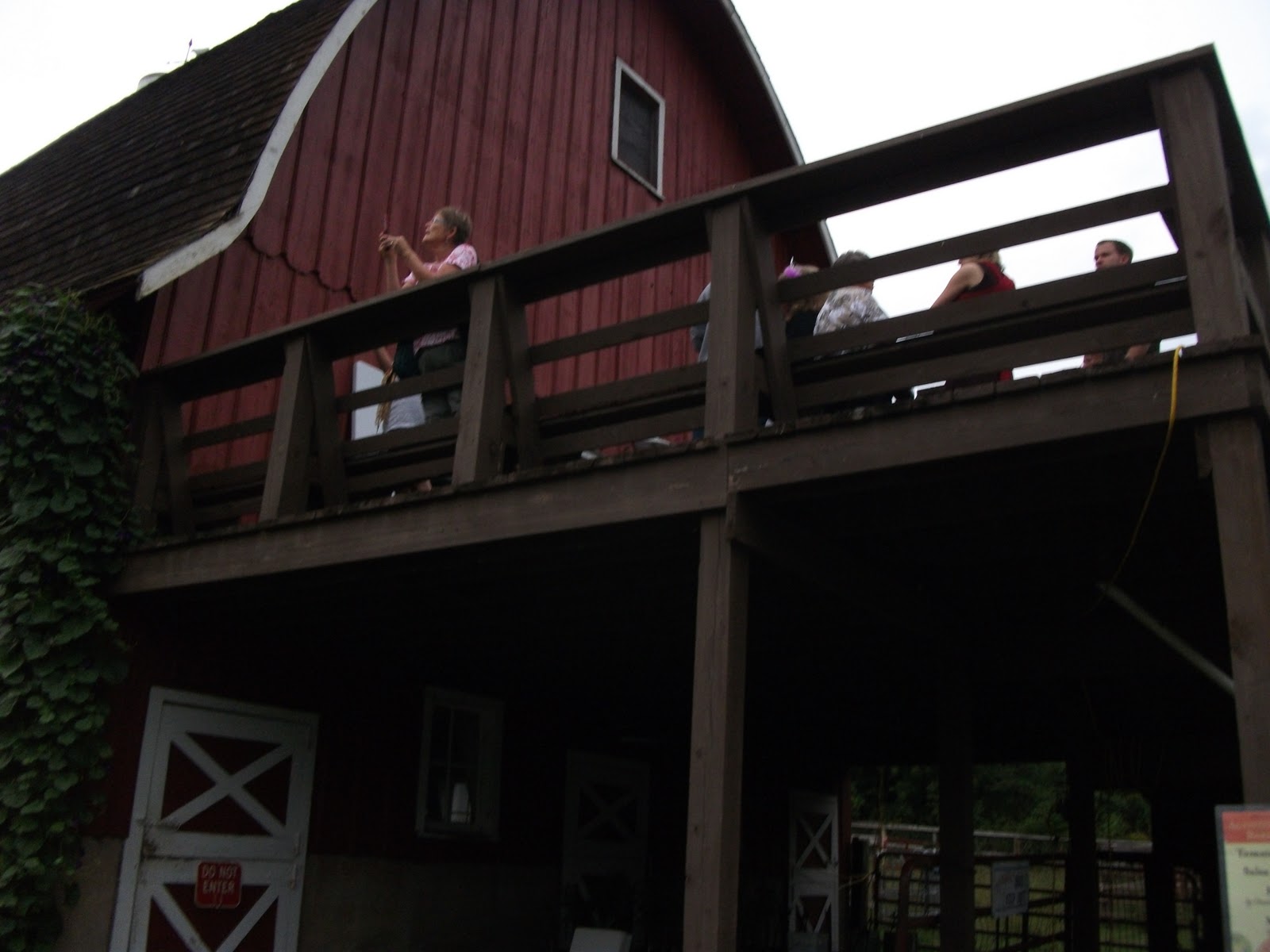
I should pause for a second to point out that the Seed Savers estate contains a very nice white farmhouse, which houses the administrative offices; a combination event plaza and gift store, where you can purchase all the seeds your heart desires, along with a healthy assortment of cookbooks, clay pots and other back-to-nature items; and a large barn. I’m not entirely sure, but I believe the barn used to house the cattle Seed Savers owns. What I can tell you, though, is that there is a huge ramp leading up to the second story of the barn, where Seed Savers had crammed in the tomato tasting, the salsa contest, and even the polka band. My family and I dutifully got in line and after a few minutes were able to partake of the tomato tasting.

The ramp to the second floor
I’m not sure how many kinds of tomatoes you’ve tasted in one sitting. My guess would be one, and your thought was probably something along the line of, “Huh, this tastes like a tomato.” When you taste thirty different types of tomatoes, though, it’s a different story. Some tomatoes are tangy. Some are mild. Some are juicier, some have more of a “tomato” flavor. Also, around type number fifteen your tongue says “screw it,” and the rest of the tomato types start to taste somewhat similar. I imagine if you’re a real tomato connoisseur you’d be in heaven, but for us “Joe Tomato” types it was hard to describe each kind. At the end, you were invited to vote for the best tasting tomato, and I did, although it was one of the first fifteen. I kept wondering if the other tomato types were getting shafted in the voting process. In the end I suppose it’s not that important, but it’s still worth considering.

Nothing makes people smile like free salsa!
After the tomato tasting was judging the salsa contest, which was a LOT more fun. Personally, I like tomatoes, but on their own they’re not that exciting. For a tomato’s true appeal to shine through, you need to chop it up and sauté it with onions, garlic and hamburger to make a spaghetti sauce, or include it in a BLT, or use it as in ingredient in a salad. Or use it in a salsa, which is in my mind the pinnacle of tomato recipes. The salsa contest’s rules were very simple—go through the line and taste each type of salsa. Tortilla chips were included, because it would have been gauche to taste salsa with anything else. When you are done, vote for the salsa you like the best.

The sister-in-law. More commonly known as "Natalie."
The salsa contest is my favorite part for two reasons. First, homemade salsa tastes good. Even the most mediocre salsa can run rings around any store-bought salsa, simply due to freshness of the ingredients. Secondly, every salsa recipe is different. Fruit salsas are common, where traditional ingredients are combined with mangoes or, in the case of my sister-in-law, peaches, to make a salsa that tastes different, but still pretty good. One salsa I tasted last year had avocado mixed in. Some turn up the spiciness level to “medic!” while others are mild and subtle. Finally, each salsa has the recipe printed out on a slip of paper next to it, which is one of the grandest parts. Like the salsa? Make it yourself! For the last couple years this has resulted in a lesser Tomato Tasting Festival tradition, where my family heads to the nearest grocery store, buys a metric ton of salsa ingredients and tortilla chips, then heads back to my apartment to make salsa, play boardgames, and occasionally turn on the television if University of Michigan or Michigan State University happen to be playing. It’s a grand time, and I wish there were more events like that out here so I could lure my family to coming, at least on a monthly basis.

Tuesday, September 13, 2011

New post at last--the Minnesota State Fair!


First off, my bad. I haven’t posted on here in a week, mostly due to my family being around. Trying to write when company is over is hard enough, but try to get some writing done when there are six people spending time in a one-bedroom apartment! It’s a superhuman writing feat. I, alas, am not superhuman.

So what did I do with my family the whole time we were here? I’ll get to that this week. The thing that stands out most in my mind, though, is the Minnesota State Fair. The Minnesota State Fair has the distinction of being the third largest state fair in the United States, and with that kind of recognition comes a responsibility, if you will, to have events that are truly great, to have displays lesser state fairs might shy away from having. This translates to having some truly awesome bands at the grandstand. Such as Def Leppard, who I saw and cheered without any trace of irony.

The Minnesota State Fair also means butter sculptures of the Princess Kay of the Milky Way contestants. If you’ve never heard of the Princess Kay of the Milky Way before, then you’ve probably never been to Minnesota. The Princess Kay of the Milky Way is the ultimate winner of an annual competition organized by, wait for it, the Midwest Dairy Association. The winner of the competition becomes the goodwill ambassador of the Minnesota dairy industry, a job that includes…well, I don’t really know what it includes, as the Princess Kay of the Milky Way page is currently down. According to Wikipedia, though, the Princess has to make “numerous media and public appearances during the Fair’s 12 days and throughout the coming year on behalf of Minnesota Dairy Farmers.” The contestants all have to be unmarried, childless women under the age of 24, and completed high school. If those standards weren’t strict enough, the contestants also have knowledge of the dairy industry.

So what do the contestants get for their trouble? Again turning to Wikipedia, the Princess gets a scholarship, which is reason enough to enter almost any contest. They also get plenty of media attention, at least in Minnesota. I suspect this would make me more excited if I were a Minnesota native.

The big thing about even being the contestant for the Princess Kay of the Milky Way, though, is the butter sculpture. Each contestant gets her likeness engraved in a 90 pound block of butter that is roughly life-sized. As my family and I went to the butter sculpture exhibit, one of the princesses was having her likeness carved in butter. For obvious reasons, the butter sculptures are stored in a glass-walled refrigerator. The Princess Kay contestant was sitting in the refrigerator, too, a parka over her evening gown, wearing her sash, and smiling and answering questions for the gathering crowd as a woman was carving the contestant’s face into the butter. I am not sure what I would do if I were to enter a contest where one of the prizes was to sit in a refrigerator while I had a 90-pound block of butter molded in my image.

Then there’s the matter of the sculptor herself. There was a news item that the sculptor, one Linda Christensen had been making these butter sculptures for 40 years. That’s mind-blowing if you think about it. Carving butter has to be one of the most specialized skills on earth, and I can’t imagine that your average art school has a course on using butter as a medium for sculpture. If there was such a school, though, I’d love to hear their thoughts on margarine. Regardless, I wonder what Ms. Christensen does during the other 353 days of the year when she isn’t carving butter at the Minnesota State Fair. Does she refine her technique? Does she take butter sculpture commissions? For that matter, what does she do with all the leftover butter from the sculpture? Is her family sick of butter yet?

One last point about Ms. Christensen is that you would expect a woman who had been carving butter for 40 years to be, well, old. Ladies and Gentlemen, I can tell you that she does not look like a woman who has been carving butter for 40 years. Maybe 20, tops. She looked timeless, in the same way Paris Hilton won’t after another 20 years. Women who want to look timeless may want to visit Linda Christensen at some point and see if butter carving is the next beauty regimen.

Another point to be made is that the Princess Kay contestants are not selected on looks alone. This is either good or bad, depending on your point of view. I heard a few unkind comments about the size of the Princess Kay contestant seated in the refrigerator,  and I suppose if you want to hate a contestant in one of these pageants for not looking good enough, fine, but let’s face it—beauty is a part of any pageant, and the 2011 Princess Kay of the Milky Way looks fantastic. So justice has triumphed in the universe, etc. etc. I’m actually surprised the people with the nasty comments kept it to themselves—it would have been pretty easy to humiliate the woman, because I would think when you’re in a refrigerator having your sculpture carved as a reward, you’re probably not at your most guarded. The haters had the shot, so why didn’t they take it? I’d like to hope it was because they had some shred of dignity.

As my family and I were watching the butter sculptures, I noticed a face in the crowd I had seen the previous year—a young woman who was hard to miss, for all the wrong reasons. She was obviously not well. She had no hair, and her physique was somewhat less hardy than your standard famine victim. Her face had a kind of squashed-in look, but what got me was her smile. The year before, I hadn’t seen her smiling much at all, and when she did it was as though she was trying to copy the way she thought a smile should be. This year, she was smiling a lot more, which made me happy. It was still a smile that was brittle, but it was there. I wanted to go over and talk to her, but something didn’t feel right about it. Next year, however, if I see her there I intend to. Both times she’s been at the Princess Kay exhibit, and I wonder if it’s a coincidence or if there’s something that draws her there.

After the butter sculpture exhibit, I actually got a chance to shine at a karaoke stage. I got up, sang U2’s “Vertigo,” and I actually did a pretty good job with it! It’s hard to look at a crowd while you’re doing karaoke, but I could see some people clapping and bobbing their head in time with the music, and I got some pretty decent applause when I finished. One of the nice things about karaoke is that everyone accepts that you’re about to get up in front of people and potentially make yourself look foolish. If you get up there and it turns out you have the singing talent of a trout, you can still get points from the audience if you grit your teeth and finish the song anyway.

The high lasted until the Minnesota State Fair’s annual talent competition, where it was replaced by awe. There are some seriously talented people in Minnesota including a 10 year old girl who—I’m not making this up—played Chopin blindfolded. Blindfolded. As my brother Steve pointed out, “Not even Chopin played Chopin blindfolded!” By far the most fun I had was in the open division, where a guitarist blasted out his own original composition, a power metal guitar solo that by all rights should have had everyone’s hair blasted back. It was wonderful.

After that, we started to head home. It was a great day, but the addition of family made it that much better.

Tuesday, August 30, 2011

Friday Nights at the Heritage House


One of the best places to dine in Cresco is a place I have trouble calling a restaurant, really.  It’s called the Heritage House, and it really exemplifies that Midwestern spirit of making your own way.

The Heritage House used to be a church. I don’t know what denomination. I really want to say Protestant, just because all the Catholics in town gather at the Nortre Dame chuch/school/social center/probably bingo hall too.

Regardless, the church was closed down and abandoned. Then a woman bought it with the intention of making it into a restaurant (and still that word doesn’t seem right). Thus, the Heritage House was born.

So, why doesn’t the Heritage House feel like a restaurant? It does serve food, after all. And you have to pay for said food. That’s pretty much the defining characteristic of a restaurant. But the Heritage House also does things I’ve seen no restaurant do.

For instance, the Heritage House has no wait staff. None. What they have in place of a waitstaff is the local troop of Boy Scouts, who volunteer when the Heritage House opens for Friday dinner. The kids bring up food, clean plates and tables, man the drink station (one soda dispenser) and when not faced with an immediate task they mill around, talking amongst themselves and acting like they’re teenagers who came to volunteer because their organization signed up for it. Lest anyone think I’m  being mean to them, I’d like to point out that teenagers who actively try to help and seek out new tasks when their organization has volunteered is almost a statistical impossibility. The teenagers that are rushing around and looking for new tasks to do either suggested the volunteer work, or their parents are chaperones.  Also, in fairness, the Boy Scouts do a good job of making sure things are running smoothly.

Another thing that makes me refuse to believe I’m in a restaurant is the amateur feel. Not amateur as in “they don’t know what they’re doing,” amateur as in “unpolished.” The Heritage House is here to serve you food. That’s it. The chairs and the tables are of the fold-up variety, as though the place is just a restaurant some of the time—the rest of the time it will be hosting some grand event. I’ve gone there a few times, and each time I buy a meal with a check (no credit cards accepted) at a setup that reminds me of the ticket tables for high school basketball games. I mentioned low dining previously, and this is low dining at its finest. One of the great aspects of this is that you have to sit with other people. There are no tables for one or two. You will be joining a group, and you can only not talk with someone if you are really willing to work at it—and really, what fun is that? I’ve eaten with a couple Catholic priests (there for the fish), an old couple who knew practically everyone, and one of the few people I know in this town who was eating with his family. 

The final thing that makes me refuse to believe I’m eating in a restaurant is that I am eating in a church. There is no polite way to say this—once a building has been a church, it leaves that imprint on every future occupant. I’ve been to an advertising agency in Waterloo, IA that is a converted church, and it still has that reverent feel. Even when an office has two old first class airplane seats in it the place feels like a church. Perhaps the only place I’ve been that hasn’t felt like a church after being repurposed is the Temple Club in Lansing, Michigan. Even there, I saw the emptiness of the sanctuary converted into a dance floor and thought, “Someone’s going to hell.” There were cute girls dancing, though, so I eventually reached the compromise that I might indeed be condemned to Hell, but I would at least enjoy the trip.

I get that same sense in the Heritage House. Not that I’m going to Hell, but that eating and paying for it is not something you should be doing in a church. As I’m eating and staring at the stained glass windows along the walls I keep thinking that I’m butting into a weekly potluck, and since I didn’t bring a dish I have to pay for a plate.  No matter how often I eat there I keep thinking I should bring a casserole.

The only problem with the Heritage House is that I don’t know how much longer it will be open. I’ve heard the woman who opened it is extremely sick. If she doesn’t make it the future of the Heritage House is in doubt, which is really too bad. It would be nice to see something she founded go on, especially something that does such a great job of bringing people together.

Tuesday, August 23, 2011

Floating to Nowhere on a Mississippi Riverboat


“Tell you what,” said my co-worker “Spader”, “Let’s go the Lady Luck riverboat casino tonight! We’ll chow down at the all-you-can eat buffet and spend an hour playing at the casinos. What do you say?”

“No thanks,” was my first impulse. This was my first free weekend in two weeks, and I had two more full weeks ahead. I had been running on fumes for the past hour, and prior to Spader showing up, my Friday night plans had consisted of swimming, going home and watching TV. It was going to be a glorious night of dullness. Then I thought of my three brothers, each of whom would jump at the chance to do this, and I remembered that I had seen the riverboat casino a couple times when I had driven from Cresco to Madison. It was interesting. It was intriguing. Most of all, it was in northeast Iowa. What the heck.

“Sure,” I said. “Let’s do it after I get done swimming.” Spader agreed, and the night was sealed.

I have never been much of a gambler. I love to read about the gamblers of the Old West, and I’ve seen the movie Maverick a dozen times or so. In various role-playing games I’ve played gamblers who make their living by their wits, which stacks up to gambling in the real world in much the same way children fighting each other with broomsticks prepares them for Olympic fencing matches. Granted, I had been in a casino or two when our family visited Las Vegas when I was, say, 16, and I had been to a few gambling parties where I had sat at the blackjack table, promptly lost a quarter of my stash, then spent the rest of the night sitting at three-quarters of my original holdings, trying to win it back, and feeling that this qualified me as a master gambler while my friends were tripling their winnings at the same table. Still, I picked out a twenty dollar bill from the local ATM. It would be an interesting northeast Iowa experience, after all. And twenty dollars would at least let me gamble a little and report on the experience.

The Lady Luck Casino comes in two parts. The entrance is the buffet, while a flight of stairs takes you to a walkway that inexplicably bends as you cross the highway underneath to the riverboat, which holds the casino. Outside the buffet building, we saw a red pickup truck with an extended cab sitting underneath the casino sign. “Win this Truck!” the sign in front of it said. I should point out this wasn’t an offer. It was a command. An order from on high. Thou shalt enter the casino, thou shalt engorge thyself at the buffet, thou shalt win this truck. Of course, this is what casinos are all about, and as Spader and I walked inside the casino’s building I saw more offer-commands. Win the weekly laptop giveaway! Win at bar trivia until 10 pm! Everywhere you looked there was an opportunity to win, dampened only by the fact that inside the casino smelled like the lobby of a cheap motel. You can’t take offers to win seriously when you’re surrounded by the scents of cheap cigarettes, air conditioning and flop sweat.

The buffet was nice, if unexceptional. The focus was placed on quantity and variety. Quality was still present, but running a distant second. Not that the food was bad, mind you—it just all had the same bland cafeteria taste to it. I ate a couple broasted chicken drumsticks, for instance, then had a smallish flame-grilled sirloin steak which I realized was not a broasted chicken drumstick primarily because of its floppiness when I picked it up with my fingers. Not to denigrate the cooks, who were shoveling food into the stainless steel trays at a rate just below how quickly the buffet customers were shoveling the food onto their plates. The cook in charge of filling the steak and potatoes section, for instance, rushed out and filled up the baked potato tray with baked potatoes he held in a stainless steel bowl. Then he rushed back through the double doors and came out almost immediately with some crab legs. He rushed back in as I helped myself to some crab legs and went on.

Then there was the casino itself. I cashed in my $20 for chips, and astonished both myself and Spader by proceeding to lose $15 at craps. Personally, I thought the game was quite interesting, from the way the rules worked to the casino chatter to the guy with the beer gut straining at his black t-shirt who told me loudly to “get your hand outta the area!” Fortunately, a helpful casino worker explained to me that one of the superstitions of craps players was that no hands should be in the dice-rolling area. Apparently it messes with the dice-rolling mojo or something. While I’m not a stranger to dice-rolling superstitions, this one seemed particularly moronic. I could see it well enough from the other players’ point of view—if a roller bounces his dice off your hand and it comes up seven, you’re going to be blamed for the turnout of the dice. From the point of view of the roller, though, it doesn’t make sense. Dice are random, which is why you’re gambling when you use them. Still, I kept my hands out of the dice-rolling box,  and let the man in the black t-shirt lose until he left the table, while Spader proceeded to win forty-six dollars, which proves one of us knew something about gambling.

During this time, I noticed that the only people in the casino who seemed marginally happy or nice were the casino workers. They talked up the games, encouraged the gamblers when they bet, congratulated them when they won and consoled them when they lost. The gamblers, on the other hand, were focused solely on winning and losing, and the pain and pleasure thereof. You might find the same self-concern in a courtroom or a holding cell. Another interesting thing—these weren’t the sort of people who looked like they had won fortunes through gambling. No, these were people who were hoping for that one big win in their lives, the one that at least gives them an extra paycheck’s worth of money in the year, or the one that lets them live the life of luxury they’ve always wanted.

Neither Spader or I was going to press our luck any more that night, so we stopped by a Mississippi Stud poker game against the house. This was by far the most interesting part of the night. Two senior citizens and a woman who seemed to be an honorary senior citizen were busy looking at their cards and laying bets. Here, unlike almost every other table at the casino, the people playing were not only talkative but helpful. They were clearly enjoying themselves, and a gentleman with a ponytail and bear wearing a tan Hawaii shirt explained that the rules. Players got two cards, the dealer laid down three face down. The players looked at their cards and made their bets or cashed in, then the dealer flipped over the first card. Then the players raised their bet or cashed in. The dealer flipped over the other cards and cash was distributed or taken away. The rewards were helpfully printed on the table.

While the people at the table were enjoying themselves, I didn’t see any money being won over the long term. For me, this would be a clear incentive to stop playing, but these three were enjoying themselves. I don’t know why. Perhaps this was their entertainment, the same way other people eat at expensive restaurants or go to rock concerts. Perhaps they just couldn’t get enough of the game. Or perhaps they took an extreme long-term view, even longer than the night, and they actually won over time. Nevertheless, what absolutely riveted me was the stacks of five dollar chips each player had, and how they kept shrinking as the night went on.

It’s not hard to see the allure of gambling—one big win is all it takes to set you on the path to Easy Street. You can make your fortune if your timing is good and your luck is right. It’s also not hard to see why gamblers in fiction are so revered. It takes a special breed of person to, say, make a living winning poker games. Think James Bond, and how he rarely loses in Monte Carlo or Las Vegas. For that matter, in Casino Royale his whole mission is to break the bank of a weapons dealer’s casino so his plans fall through!

What I’ve come to see in real life, though, is that most of the big wins are supported by a slew of little wins. Mark Zuckerburg, for instance, didn’t become a billionaire because he was lucky. He became a billionaire because he had a good idea that he capitalized and exploited for years until it became ubiquitous. And he’s still working on that idea! Bill Gates didn’t get rich because he created Windows. He got rich by putting together a business and constantly working on said business. Yes, timing was probably involved, and if luck wasn’t involved, then they at least had the wherewithal to avoid the various pitfalls and setbacks that plague any businessperson. But they won slowly, gradually, until a newspaper reports that Zuckerburg and Gates and multi-billionaires and everyone thinks, “Hey, they just suddenly became billionaires! If only I could do that too!”

I thought of winning a little at a time at a steady pace on the drive back. The night had fallen earlier, and Spader and I both discussed the casino. Spader mentioned that there were two other casinos about an hour away from Cresco, and said we’d have to see them sometime. Personally, I wondered how many casinos northeast Iowa could support.