Friday, August 24, 2012

Kendo Camp--Three Days, One Blog


Kendo Camp, Day 1

Where do you begin with kendo? Trick question—everyone begins from a different place. Some people take a class because they’re curious about why people are running around hitting other people with swords. Other people get into kendo because it looks like fun, and face it—on the surface, running around and hitting people with sticks is pretty fun. To hear one of the teachers at kendo camp tell it, he got into kendo because his older brother was practicing the martial art.

I got into it because of the coolness factor, which I suspect drives more peoples’ decision then they care to admit. Why not? This is the chance to learn how to use a samurai sword! Think of all the movie and comic book heroes who use swords! This is your chance to be Luke Skywalker!

Of course it’s not that simple. It never is. By the time I’d learned I was light-years away from being Luke Skywalker the martial art had gotten in my blood, and no matter how many times I left, I kept coming back. Kendo is deceptively difficult, and you quickly learn that your best physical effort isn’t quite enough. You also learn all the ways that you’re screwing up with each swing of the shinai. And yet each time you screw up you learn something, and when you’re frustrated and at the end of your rope you just have to keep trying until you hit that breakthrough, which is one of the greatest feelings in life. At that moment, you know that you have improved slightly and you know how much work it took to get to that point. Anyone who wants the rewards without the journey could learn a lot from kendo.

If you keep at kendo for a few months, you may find it gets in your blood. You may find that, even though sweat is dripping onto the hardwood floor of the dojo and you just want to quit, if you had a little more time to practice you could finally perfect your form! Of course, by the time you’ve showered and put away your shinai and bogu, you want nothing more than to sleep. But the desire is still there, and the next time you pick up a sword it awakens.

Perhaps that’s why I’ve come to kendo camp here, out in Madison, Wisconsin. I’ve come despite a shoulder that complains if I use it for too long and a car whose engine tends to shake intermittently. Some things you just have to power through. Over the next two days I’ll be training hard for hours on end, pausing only to eat and then go back at it. My stomach is already tensing at the thought. Still, I know I’m going to learn something, and when I learn something here, I want to apply it to all aspects of my life to become a better person. Perhaps I’m seeking God out here, in the form of sweat and a sword. 

 
Kendo Blog, Day 2

I’m exhausted. And hurt. My right shoulder and arm are jumping the border of sore and hurt like it was nothing, and I’ve developed what is called “the kendo walk.” It looks like a duck-footed very old man, and it’s the standard method of walking unless you make an effort to walk normally. The weirdest part is that mentally, I’m still ready to go. Put a shinai in my hand, give me some bogu to hit and let’s get to it. I expect this feeling to last until about four seconds after I get to bed.

That’s the odd thing about kendo. It revs up your spirit and your mind even as your body is getting pounded. I think it’s one of the benefits of kendo—your mind and spirit get as much exercise as your body,  and perhaps one day your body will be able to keep up with your mind and spirit, or at least your mind and spirit will supplant your body’s strength. Mental and spiritual energy seem to be ridiculously long-lasting.

Yamanaka sensei and Saito sensei are proof of this. They got up at around 5:30 am like most of the kendo students and taught an hour-long session of kata outside. Then they taught two three-hour kendo sessions, and now they are in the dormitory commons room, cheerfully drinking beers, getting cheerfully drunk and staying up later than people half their age, up to and including me.

I never really understood how important the basics were until Yamanaka sensei corrected a lot about my men strike, the most basic strike in kendo. Then I started trying to do it right, and I’ve kept on trying to do it right throughout the practice. The 1st-dan and under class practices nothing but basics, and I love it. I keep wanting to practice them more and more. I don’t really care about sparring, or any of the types of sparring practice that are meant to show us how to use a sword in a “real” sparring scenario. I’ve focused on getting this one thing right. It’s not a bad feeling, either. I realize that doing it perfectly is probably not possible, but it feels almost within my reach, and the feeling I get reaching for that goal is incredible.

Kendo Camp 3

Well, it’s over. In a way I’m disappointed, because I really want to still practice kendo. On the other hand, I’m exhausted and want nothing more than to get back to my apartment and start sleeping. I’m sore, and my shoulder is letting me know it doesn’t want to be used for a while. Maybe for the rest of August.

On the other hand, I survived an intensive kendo weekend! Nine hours of practice, eleven if you count the free-form practice and the kata practice at dawn. And  I didn’t have to sit out any of them! I feel really accomplished, but more than that I started to really understand what it meant to make a good men attack. For about the last hour of practice my men attack became more and more consistent. Not perfect by any means, but much better than it was. That alone was worth the cost of kendo camp.

I’m getting my kendo gear all bundled up, pretty much all of it soaked in sweat accumulated from two days’ worth of practice. I don’t think anyone other than me would want to touch it. On the other hand, the kote, the gloves and wrist protectors, are nice and flexible, and almost has me wishing they’d be like this more often.

Again, the thoughts you have after a kendo practice can be kind of weird. You want to keep doing more kendo, for one. After reaching one goal you’re ready to try working on another, although you know deep in your heart of hearts that concentrating on another aspect of your kendo may cause the first aspect to deteriorate a bit, since you’re paying less attention to it. And that’s fine. It’s another part of learning how to do kendo, and on some level it starts to seep into the rest of your life, too. I keep thinking of things I want to improve, and instead of wanting to juggle everything all at once, I think I’m okay with focusing on just one aspect and improving from there. The result is, to quote the Eagles, a peaceful, easy feeling, a feeling that yes, you can handle whatever is thrown at you in work or relationships, with family members or coworkers. It’s odd that all of this can come from learning how to swing a sword properly, but there you go.

Also on the third day at kendo camp? I let go of fear. Not that I didn't experience it, that feeling where your guts tighten up and your legs feel rooted to the ground. But when I started practicing on the third day I let go of all the fears I had--fear that my shoulder wouldn't last through the practice went first, then the fear that I wouldn't do good kendo, and finally other fears just went away and I was practicing kendo, accepting that whatever would happen to me would happen, and more importantly that I could deal with it. I don't know for certain, but I think that's what is known as the zen mindset.

Time to make the drive home.


Wednesday, July 25, 2012

The Howard County Museum and the Toughest Sherriff ever


Another year has passed, and the Mighty Howard County Fair has come and gone. I’m not going to write much about it this year, because county fairs are not exactly known for how much they change from year to year, and let’s face it—I don’t want this blog to keep covering old ground, which is one of the reasons why the posts are getting more infrequent.
                 
Still, the area has a few surprises left in her. If this blog is to be anywhere near a complete showing of what’s interesting and neat about this area a few more posts about Decorah are necessary. So is a post about the Howard County Museum.
                
 When I was growing up in northern Michigan, one of the places that I was always interested in was the Steiner Museum. A quick flip through the old Merriam-Webster says that museums are buildings “in which objects of historical, scientific, artistic or cultural interest are stored and exhibited.” Going by that definition, the Steiner Museum was indeed a museum, although with the way things were stored one could also mistake it for a warehouse, or one of the more interesting episodes of “Hoarders.” Regardless, I liked seeing all the old relics of yesteryear, including some attempts at capturing history like a photo album of a particularly controversial decision by the Michigan Department of Natural Resources that was protested by some locals with a vehement “Not in my backyard!” attitude. Despite the chaotic layout of the place, I do have a soft spot for it. It takes dedication to run a small museum, especially because when most people think about history they only think about the big things that happened in a country. People want to see Teddy Roosevelt’s spectacles or Napoleon’s military garb or the car that was driving JFK when he was shot in Dallas. But history is made up of smaller names too, the nameless people who were pilgrims, the foot soldiers in the American Revolution, not to mention the farmers, the ranchers, the doctors, and small businessmen who did everything from sell groceries to rooms at a hotel. If you think about it, they’re the unknown giants of history, the ones upon whose shoulders stand the truly exceptional human beings we revere. 


So what would I find in the Howard County Museum? As it turned out, the museum had recently received an old-fashioned Nickelodeon, which they had gotten refurbished from whoever refurbishes Nickelodeons. For those of you who have no idea that a Nickelodeon is anything other than a cable channel that caters to children, let me give you a brief description. First, picture a player piano, only this doesn’t have a visible roll of music. Instead, it has some elaborate windows carved into the wall of the piano that lets you see the keys. While this would no doubt be thrilling if a concert pianist were to play a Beethoven concerto, the real fun comes when you put a nickel in the machine. Then the device comes alive, as the keys press down, and the inside of the piano lights up so you can see the keys striking the notes. Comibine it with a cheery little dance hall tune, and suddenly the idea that our ancestors ever got bored on a weekend seems absurd. I watched the Nickelodeon play for a few minutes and I was utterly entranced. How could you not get tired of this? I pictured a few saloons open on the weekend, with people dancing a pleasant little two-step with each other, and when they got tired gathering around the Nickelodeon, a cold beer in hand, chatting with their fellow Howard County residents, occasionally letting a moment of silence enter into the conversation so everyone could take a few seconds to watch the Nickelodeon and consider that life really wasn’t that bad. 


 After the attraction with the Nickelodeon had worn off, I started looking around at the rest of the museum. There were a selection of army jackets, most from the days of World War II, all made out of wool and sporting patches and insignias, a code that only their brothers in arms could read without effort. Further inside were old barber chairs, dentist chairs, and contraptions that must have been considered futuristic at the time they were introduced, like a salon chair with curlers descending from the central power supply on thick insulated tentacles. It looked like an alien torture device. Of course, since Howard County was built on farming, there were a few very interesting farming implements, most of which looked like monstrous versions of the current farming implements I’ve seen. Granted, the farming machinery today are arguably bigger and look crazier, but they’ve also look newer and have much better paint jobs. 


For my money, though, the most interesting thing at the Howard County Museum was the memorial belonging to the Cresco Sheriff  Percy Haven. Percy came to Cresco in the 1930s, and got the job of Sheriff because the position was vacant and somebody needed to do it. At 6’4”, Percy was that someone. I can’t reproduce the articles, but the picture painted by Percy’s obituary was one of a man who was John Wayne before there was a John Wayne. He apparently cleaned up the town, even though the town didn’t seem to need that much cleaning up in the first place. There were a few accounts of his toughness and fairness, but the one that really stands out is how he told an FBI agent to get out of town after the agent demanded a criminal in Percy’s care be turned over to him. Percy refused until the criminal was tried and sentenced in Howard County, and when the FBI agent tried to pull rank, Percy told him in no uncertain terms to buzz off. The FBI agent went away empty handed. In the 21st century that’s all but unthinkable, and I’m not sure it was much different back in the day. After all, Iowa and the Midwest were not exactly untamed by that point. Yet Percy embodied that Old West spirit. He must have been an incredible figure, but all the same I’m a little glad he was before my time. I’m trying to imagine getting pulled over by him, and I can’t help but think that even a routine traffic violation would turn into a pants-wetting experience that would instill in the offender a deep-seated desire to always abide by the law, lest they run into Percy again.

The museum was really interesting, and I have to wonder if any other county museums are out there, and where they might be located. If I happen to find them, I’ll let you know.

Wednesday, July 4, 2012

The First Ever Decorah Comic Convention


When my co-worker Mark asked during a business lunch if I’d heard anything about the Decorah Comicon taking place at the end of June, my first reaction was to ask him if he was joking. Even after he said he wasn’t, it still took me seeing the poster in a store window to accept that it was real.
While Decorah has some places that cater to those with geek interests (video games, comics, role-playing games, anime, and let’s be honest here an interest in reading), by and large the place that is the most geek-friendly is a video game store called The Game Exchange. This is where you’ll find high-school kids hanging out playing video games or checking out the used bric-a-brac that lines the walls. Most of it is old gaming paraphernalia, like some old Nintendo controllers, but there is the occasional Transformer. The store also sells comic books, although all of them were published in the nineties, a time universally considered by fans to be the nadir of comic book art and writing. It’s conceivable that the store owner actually bought those comics in the nineties and has just been unable to sell them. 


Another issue with having comic book conventions is that you need to have people who are willing to attend them. This was the part that worried me. A couple years ago, a guy named Matt had gotten together a group of people at the local bowling alley who might be interested in doing some gaming, and said group of people had promptly broken up to go their own separate ways. Needless to say, I was a little skeptical about how this comicon would play out. Maybe 20 people would show up. If the organizers were really lucky, they’d get 30. Even so, I was going. I don’t consider myself much of an organizer, and usually when I try to promote something about which I’m really passionate, I usually receive massive waves of indifference. So someone taking the time to organize a comic book convention in Decorah, much less opening it up to the general public and encouraging people to come in costume, or cosplay, as it’s known in comic book circles, was an act of bravery that deserved to be supported.  So on Saturday I went out to Decorah to the VFW hall and entered the Decorah Komicon. 

The first thing I noticed was that the VFW hall is a remarkably depressing place. If you take a church’s community area and combine it with a cheap bar, you have a good idea of what the Decorah VFW hall is like. I was there once before on a Saturday night, when an acquaintance had suggested we “hit the bars and go dancing.” Apparently the VFW hall is considered a bar on Saturday night, and it was populated by two or three men in their sixties or seventies, sipping beers while a DJ played a schizophrenic mix of 21st century pop and old country tunes. It was like attending a high school dance, only with a crusty bartender serving overpriced drinks. This time around was slightly different—there were still overpriced drinks, but the con organizers had seen fit to provide snack-sized bags of chips to everyone at the con for free. As an experienced con goer, this amenity immediately elevated the con to the ranks of the greats. 

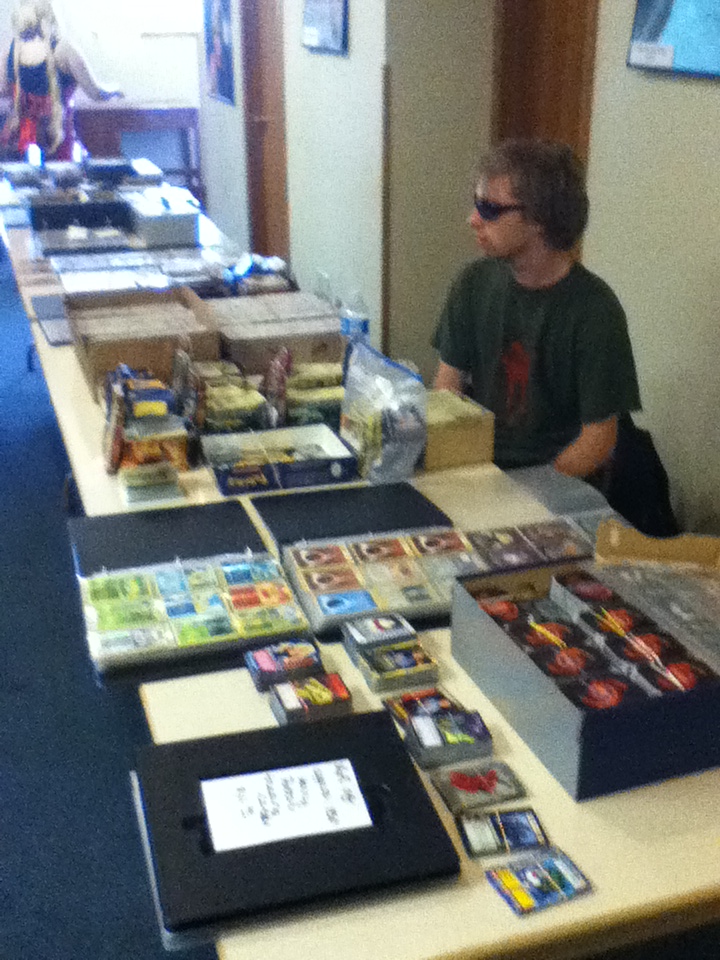
As expected, there weren’t a lot of people at the con, and most of them were in high school. Still, there were quite a few twenty and thirty somethings in the crowd, and a few of them were selling their artwork. It was really cool to see. They weren’t professionals, just fans who really liked to draw. Another surprise was that the con had invited some local merchants to sell their wares at the con, and a surprising number had taken them up on it. The secondhand games and DVD store had out a selection that Comicon attendees would find attractive, and The Game Exchange had its rack of 90s comics transplanted to the VFW hall in case anyone was comic-deprived enough to buy them. Some guy was selling issues from his collection, and the con had even gotten t-shirts printed! 

The con even had panels. There were talks about figure collecting, the history of comics and a talk about comics, stories and religion that I’m sure has never been attempted at any other con.  The basement contained several video games consoles that had been set up, and in a darkened corner there were a couple of kids watching some old X-Men cartoons. It was wonderful. 

The thing about being a fan of comics, video games and the like is that, even with the proliferation of comic book movies in the mainstream, they always have the stigma of being childish, and there’s still a consensus  that you can like them, just don’t like them too much and for God’s sake, don’t like them if you’re an adult. Being able to take off your mask for a bit and talk shop with other people who have the same interests is liberating, and I certainly enjoyed being able to do so in Decorah. 

One of the best parts about the Decorah Komicon was Lindsey, who works at the local DVD rental shop. I talked with her about why she had wanted to put this con on, and she said that she had always liked going to the Anime Iowa convention in Iowa City until it finally became too expensive. So she decided to create a convention closer to home that would attract people. She hoped it would get bigger each year, and while I don’t know what the future holds, I would say that based on the turnout and enthusiasm a Decorah Komicon 2 is likely.